I have been playing guitar for over twenty years and teaching for most of that time. And the question I hear more than almost any other — from beginners, from people who have been playing for years, from parents enrolling their children — is some version of this:
“Do I actually need to learn music theory?”
The honest answer is yes. But not for the reasons most people assume. And nowhere near as painfully as most people fear.
This is what music theory for beginners actually is, why it matters, and how we teach it at TFC in a way that makes immediate, practical sense.
What Music Theory Actually Is — No Jargon
Most people hear “music theory” and immediately picture a classroom, a dusty textbook, musical notation they can’t read, and terminology they don’t understand. That association puts a lot of people off before they’ve even started.
Here is what music theory actually is, stripped down to its simplest form:
Music theory is the explanation for why certain things in music sound the way they do.
That’s it.
When you hear a song and feel something — tension, release, sadness, energy, anticipation — there is a specific reason that feeling is being produced. Music theory is the vocabulary and the understanding that explains what that reason is.
When you play two chords together and they sound right — there is a reason they sound right. When you play two chords together and something feels slightly off — there is a reason for that too.
A musician without theory is guessing at those reasons. Sometimes they guess correctly, by feel and repetition, and that is genuinely valuable. But a musician with theory is not guessing. They are deciding.
That is the whole difference.
You do not need to be able to read sheet music to understand theory. You do not need to study harmony for years before it becomes useful. The core concepts that change how a beginner approaches the guitar can be understood in one afternoon — which is exactly what the Saturday Session is designed to do.
Why Players Who Know Theory Improve Faster
The most visible effect of understanding even basic music theory is the acceleration in learning speed.
A player without theory learns individual songs, individual riffs, individual techniques — one at a time. Each new song is essentially a new thing to memorise. The knowledge doesn’t transfer cleanly because there is no underlying framework connecting everything.
A player with even a basic theoretical foundation learns differently. When they understand that a chord progression is built on specific scale relationships, every new song that uses a similar progression is not a new thing to learn — it is a familiar pattern in a new context. The knowledge multiplies.
This is why two players can start at the same level on the same day, and after six months the one who has some theoretical understanding is noticeably further along — not because they practised more, but because every hour of their practice was more efficient.
They weren’t just learning songs. They were building a framework that made learning the next song faster. And the one after that. And everything after that.
There is also the improvisation effect. A player without theory can play things they have memorised. A player with theory can play things they have never played before — because they understand the rules well enough to navigate within them.
The Most Important Concepts for Beginners
You do not need to learn everything at once. In fact, trying to learn everything at once is one of the most reliable ways to learn nothing at all.
These are the five concepts that give a beginner the most immediate and practical benefit:
The major scale. This is the foundation of almost everything in Western music. Seven notes. A specific pattern of intervals between them. Once you understand the major scale — and why it sounds the way it does — a significant portion of music theory starts to make sense automatically.
Intervals. An interval is simply the distance between two notes. Understanding intervals tells you why certain notes sound tense together, why others sound resolved, and why a minor chord feels different from a major chord. Intervals are the atoms of music. Everything is built from them.
How chords are built. A chord is not a random collection of notes that someone decided sounds nice. It is a specific set of intervals stacked in a specific way. Once you understand this, you can work out any chord. You also understand why chord substitutions work — a piece of knowledge that dramatically expands what you can do on an instrument.
Chord progressions and how they relate. In any given key, certain chords naturally belong together. This is not a matter of taste — it is a mathematical relationship built into the scale structure. Understanding which chords belong together in a key is what allows you to play along with a song you have never heard before, figure out a song by ear, and write your own music that sounds intentional rather than accidental.
What a key actually is. Most beginners know that songs are “in a key.” Few beginners understand what that actually means in practical terms. A key is a home base — a tonal centre that the music constantly references and returns to. Understanding keys explains why certain chord changes feel like movement and others feel like rest, why a song builds tension and then releases it, and how to use a capo intelligently rather than randomly.
None of these five concepts require reading sheet music. All of them can be learned through the instrument, through listening, and through practical application — which is exactly how TFC approaches theory.
How TFC Teaches Theory — Through Playing, Not Reading
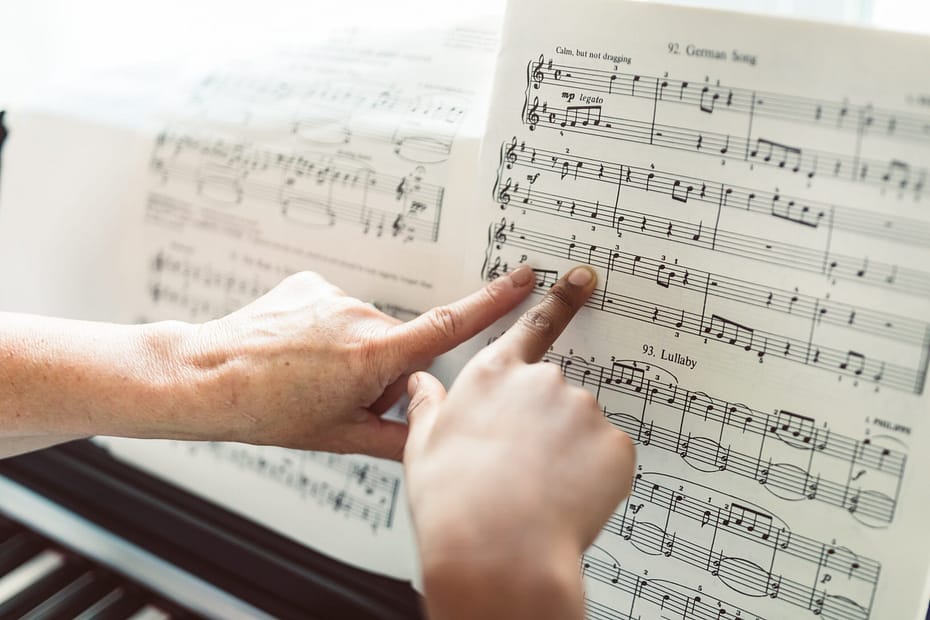
The traditional approach to music theory teaching starts with notation — reading music on a staff, understanding note values, learning time signatures before you’ve played a single chord.
I understand why this approach exists. Notation is the written language of music. For a classical musician, or for anyone who wants to read and write music formally, it is essential.
But for the vast majority of people who want to play guitar, keyboard, or ukulele — and understand what they’re playing — starting with notation is the equivalent of making someone study the grammar of a language before they’ve heard a single word spoken.
At TFC, theory is taught through the instrument.
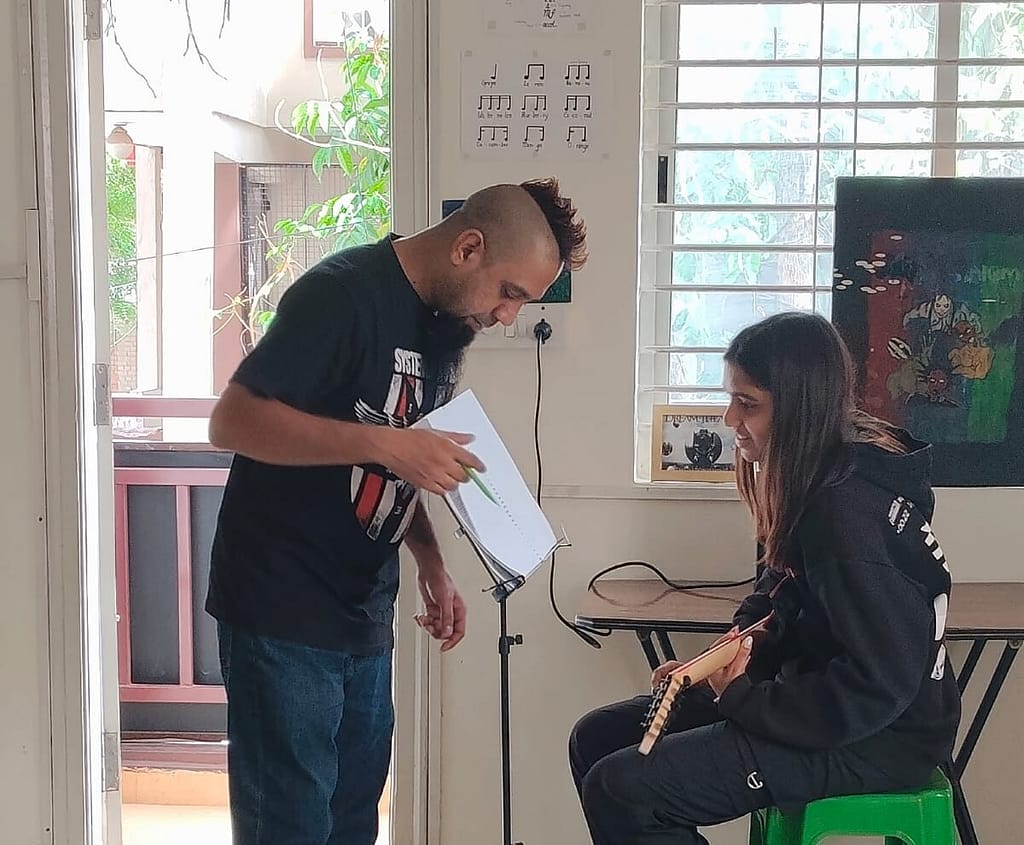
When we teach the major scale, we play it. We hear it. We feel where the tension sits and where the resolution lands. The theoretical explanation follows the physical and auditory experience — not the other way around.
When we teach chord construction, we build the chord on the fretboard, listen to what each note adds to the sound, and remove notes to hear what changes. The theory becomes inseparable from the sound it produces.
When we teach chord progressions, we play them immediately — in songs, in exercises, in improvisations — so that the theoretical relationship between chords is always connected to music the student can hear and feel.
This approach takes slightly longer to establish on paper. But it produces understanding that is genuinely usable — not knowledge that sits in a notebook and gets forgotten the moment the lesson ends.
The question we always ask at TFC is: can the student use this? Can they sit down with a guitar and apply what they just learned? If the answer is yes — the teaching has worked. If not — we haven’t finished yet.

The Saturday Sessions — Music Theory Made Simple, June 27
On Saturday, June 27th, TFC is running a dedicated music theory session as part of the Saturday Sessions programme.
The session is called Music Theory Made Simple. It runs from 12 PM to 1 PM — 1 hour — at The First Chord Academy in Banaswadi.
This session is designed for:
People who play an instrument — guitar, keyboard, ukulele, or any other — and want to understand what they’re actually playing.
Complete beginners who want a theoretical foundation before or alongside starting regular classes.
Anyone who has tried to learn theory before, found it confusing or dry, and wants to approach it differently — through playing, through sound, through music they already know and love.
No prior theory knowledge is required. No instrument is required — though if you play, bring yours.
In 1 hour you will leave with a working understanding of the major scale, basic interval recognition, chord construction, how progressions work in a key, and what any of that means when you’re actually sitting with your instrument.
The fee is ₹999. There are 15 seats. First paid, first confirmed.
📲 WhatsApp 8217506289 to register.
Regular Classes at TFC
If you want to go deeper — theory as part of an ongoing learning programme — TFC offers regular monthly guitar, keyboard, and ukulele classes where theory is integrated into every session from the beginning.
Monthly classes start at ₹2,000 for four classes per month. A free trial class is available for all new students.
For faster, private progress — TFC Fast Track offers 8 private 1:1 sessions on weekend mornings, at ₹15,000.
📲 WhatsApp 8217506289 to book a trial or ask any questions before deciding.
📍 Above IDBI Bank, Subbanapalya, Banaswadi, Bengaluru 560043
🌐 thefirstchord.com
Eric Rodrigues is the founder of The First Chord Academy in Banaswadi, Bangalore, and has performed as lead guitarist with Twisted Mischief, Ledge 13, Quarter Fret, and Negative Zero. He has taught guitar, keyboard, and ukulele at TFC since its founding.
I never thought about how music theory can impact a wedding. Do you think it really changes the vibe of the whole event?