There is a story we tell ourselves about musicians. That they were born that way. That they heard music differently from birth, that their fingers just knew where to go, that talent arrived before practice ever did.
It’s a comforting story. It gives the rest of us a clean excuse: “I’m just not built for it.” It means we never have to sit with the discomfort of being a beginner. We never have to be bad at something before we get good.
The only problem with that story is that it isn’t true.
Every musician you have ever admired was, at some point, playing the same three chords badly in a small room. Musicians are built. Not born.
What the Science Actually Says About Talent
In the 1990s, psychologist K. Anders Ericsson studied musicians at the Berlin Academy of Music. He asked one question: what separates the best from the rest? His answer was not talent. It was hours of focused, deliberate practice. The idea that the right kind of practice will build mastery in almost any field, regardless of starting point.
More recent research has confirmed what good music teachers have always known: the brain is far more flexible than we think. Playing an instrument physically changes the brain — it builds new connections, strengthens memory, improves focus, and develops fine motor coordination. None of that is inherited. All of it is built.
You don’t need a musical brain to start learning music. Learning music gives you the musical brain. The instrument comes first. The gift follows.
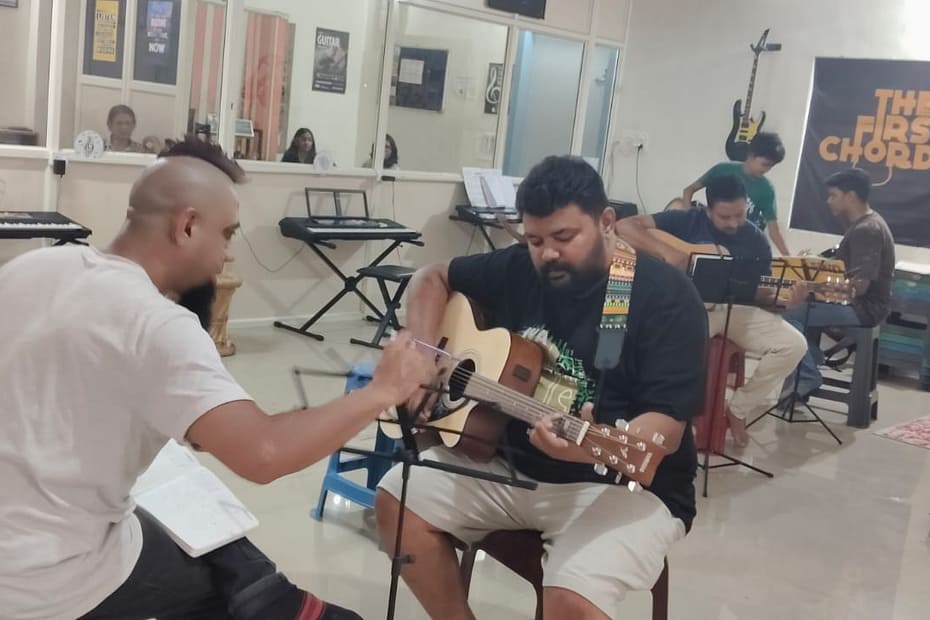
At The First Chord Academy in Banaswadi, Bangalore, we’ve taught hundreds of students who walked in believing they had no musical ability. Almost every one of them discovered, within weeks, that the ability was never the issue. The starting was.
The Three Things That Actually Build Musicians
If it isn’t talent, what is it? Three things — and only three. Every musician who has ever gotten good has these in common.
1. Practice — but the right kind
Not passive repetition. Not playing the same easy part over and over. Deliberate practice means working on the specific thing that’s hard, slowing it down until it’s right, and then building it back up. Twenty focused minutes beats two distracted hours every time. Students who practice this way at The First Chord Academy progress three to four times faster than those who just sit with the instrument.
2. Consistency — showing up when it isn’t exciting
Every musician goes through a middle stage. The beginner excitement has worn off, but real skill hasn’t arrived yet. This is the stage where most people quit — and the stage where real musicians are made. Consistency through the boring middle is the entire game. One lesson a week and fifteen minutes of daily practice, done for six months, will do more than any shortcut or crash course.
3. Small wins — celebrating the moments that matter
Motivation doesn’t fuel practice. Progress does. When a student plays a full chord cleanly for the first time, when a song they’ve been working on suddenly flows, when a parent hears something recognisable come from the room — those moments are the fuel. Good teaching means creating those moments early and often, so the student never loses the reason to keep going.
6–8 weeks to play your first full song with consistent practice
15 minutes of daily practice is all most beginners need to progress
6 months to play confidently and perform in front of others
What This Looks Like in a Real Classroom
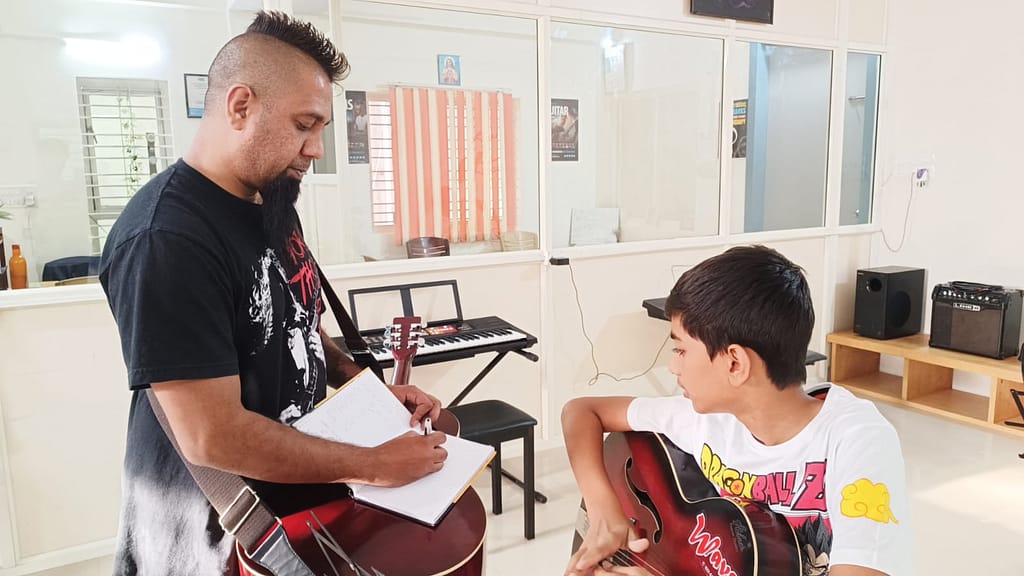
Aryan is 14 and lives near Kammanahalli. He joined The First Chord Academy convinced he had no musical ability because a school teacher once told him he was off-key. For the first two weeks, he was. But we stayed on one chord, one strum pattern, one song. By week four, he was playing a full song. By month three, he performed it at our student recital. His mother said she was happy the entire time. Aryan said it was the first time he felt genuinely good at something.
Aryan isn’t exceptional. He’s completely typical of what happens when a student gets the right environment, the right pace, and a teacher who refuses to write them off.
Deepa is 38 and works in finance. She lives in Kalyan Nagar and came to The First Chord Academy because she wanted something just for herself. She picked keyboard. She had never touched one in her life. Within four months she was playing two songs well enough to record a video. She said learning music gave her back something she didn’t know she’d lost — the ability to be a beginner without it being embarrassing.
Why Most Music Teaching Gets This Wrong
The talent myth persists partly because of how music is often taught. Traditional music education — especially the grade-exam model — sorts students fast. You either keep up or fall behind. It rewards students who were exposed to music early, punishes those who weren’t, and mistakes head-start for talent.
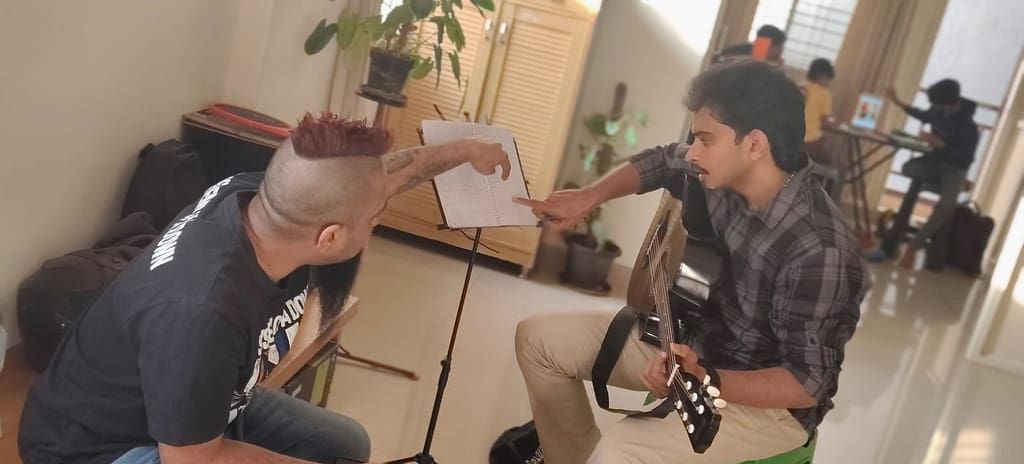
At The First Chord Academy, we deliberately don’t teach that way. We are not a grade-exam factory. We are trying to produce people who love music and can actually play it — people who will still be playing at 60 because it brings them joy, not because they’re chasing a certificate.
Every student at TFC learns at their own pace. Every lesson is built around what that student finds meaningful — the songs they love, the sound they want to make, the feeling they want to have when they play. That is how musicians are built.
What Happens When a Musician Is Built
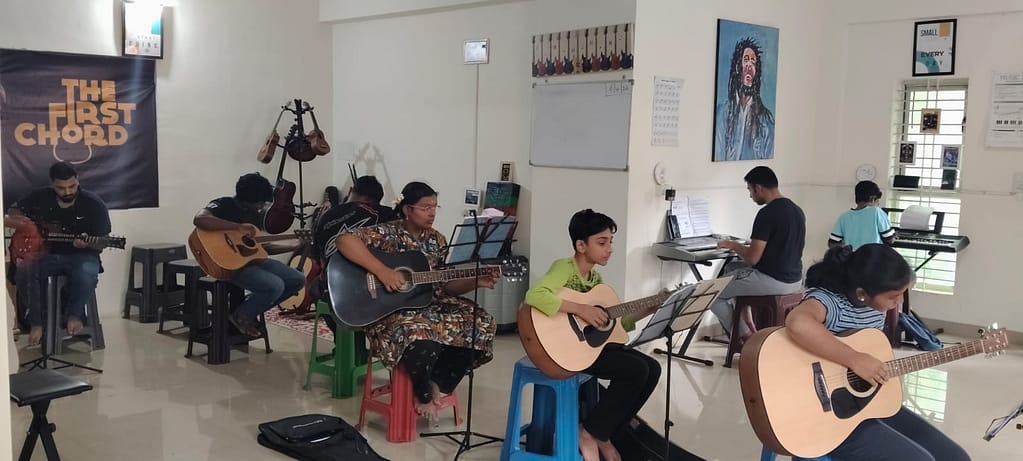
The students who stick with it find that music starts to do something unexpected. It stops being something they do and starts being something they are.
Parents of our students in Banaswadi and Kammanahalli tell us their children are more patient, more focused in school, more confident in social situations. Working professionals tell us that an hour with their guitar is the most restorative part of their week. Teenagers who came in shy and uncertain walk out of our recitals standing taller.
This is what music really is. Not a skill you acquire. A part of yourself you build.
You don’t need talent to start. You need to start — and that builds the talent.
Frequently Asked Questions
Do I need natural talent to learn music in Bangalore?
No. At The First Chord Academy in Banaswadi, we work with complete beginners every day. Musical ability is built through practice and consistency — not inherited. We’ve never met a student who couldn’t learn to play with the right approach and pace.
Can adults learn guitar or keyboard from scratch near Kammanahalli?
Absolutely. Adults often progress faster than children because they practice with intention. We offer guitar and keyboard classes for adult beginners aged 25 and above. Our academy in Banaswadi is easily accessible from Kammanahalli, Kalyan Nagar, HBR Layout, Ramamurthy Nagar, and Hennur.
How long does it take to learn guitar with consistent lessons?
Most students play their first recognisable song within 6 to 8 weeks. Playing comfortably and performing in front of others typically takes 6 to 12 months of weekly lessons and 15 minutes of daily practice at home.
What age can my child start music lessons at The First Chord Academy?
We welcome children from age 7 onwards. Ukulele is ideal for younger children aged 7 to 9, while guitar and keyboard work well from age 8 upward. Every class is tailored to the child’s pace and personality.
Are there music classes near Kammanahalli, Kalyan Nagar, or HBR Layout?
Yes. The First Chord Academy is in Banaswadi, Bangalore — a short distance from Kammanahalli, Kalyan Nagar, HBR Layout, Ramamurthy Nagar, Hennur, Horamavu, and Cox Town. We offer guitar, keyboard, ukulele, and art classes for kids and adults.