
By Eric Rodrigues — Founder, The First Chord Academy, Banaswadi, Bangalore
Every few months, a parent sits across from me and says something like: “I want my child to learn music, but I also need them to focus on their academics.”
I understand the concern. School pressure in Bangalore is real. Board exams are real. And the fear that music is a distraction from studies — that fear is real too.
But here is what most parents don’t know: music doesn’t compete with academics. For children, it actively improves them. And the subject it helps the most is mathematics.
This isn’t an opinion. It’s what research consistently shows. Here’s what the science actually says — and why it matters for your child.
What the Research Shows
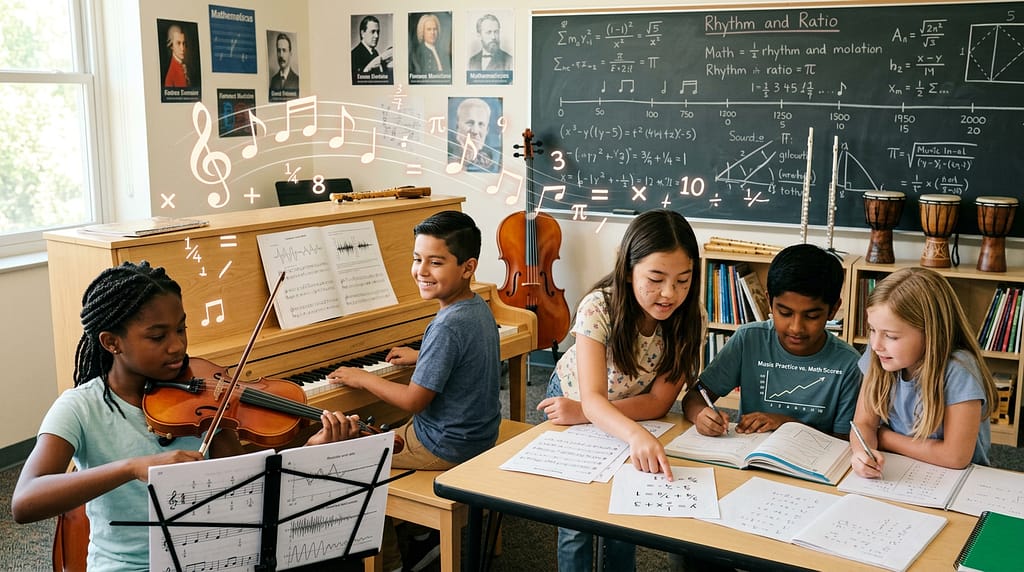
Studies published in educational psychology journals over the past two decades have repeatedly found a measurable link between music education and improved mathematical performance in children — particularly in the areas of arithmetic, spatial reasoning, and problem-solving.
A landmark study found that children who received structured music lessons showed significantly greater improvement in mathematical ability compared to children who did not — even when controlling for other variables like family background and general intelligence.
The effect is strongest when music lessons begin before age ten and are consistent — meaning regular, structured classes rather than occasional exposure.
What’s interesting is that this isn’t about music making children “smarter” in some vague general sense. The improvement is specific. And once you understand why, it makes complete sense.
Rhythm and Pattern Recognition
Mathematics is fundamentally the study of patterns. Number sequences, multiplication tables, algebraic expressions — at their core, they are all patterns that follow rules.
Music is also built entirely on patterns.
When a child learns to read and play a rhythm, they are doing something deeply mathematical. They are dividing time into equal parts, understanding fractions in a completely intuitive way, and recognising that patterns repeat, vary, and combine to create something larger.
A child who understands that four quarter notes fill one bar — that four quarters make a whole — has an intuitive grasp of fractions that no worksheet can fully replicate. They feel it. They hear it. They play it.
This is why music education researchers describe rhythm as “mathematics made audible.” The brain processes both through the same pattern-recognition systems. Strengthen one, and you strengthen both.
Reading Music and Spatial Reasoning

Spatial reasoning — the ability to mentally visualise and manipulate shapes, objects, and their relationships — is one of the strongest predictors of success in mathematics, particularly in geometry, algebra, and later in physics and engineering.
Reading musical notation directly exercises this skill.
When a child reads sheet music, they are processing information on multiple axes simultaneously. They track pitch (vertical position on the staff), duration (the shape of the note), time (left to right progression), and pattern (repetition and variation across bars). This multi-dimensional reading is cognitively demanding in exactly the way that spatial mathematics is demanding.
Children who learn to read music are, in effect, training the same mental muscles they will need to visualise a graph, understand a geometric proof, or picture how an equation changes when a variable shifts.
How TFC Combines Music and Academics
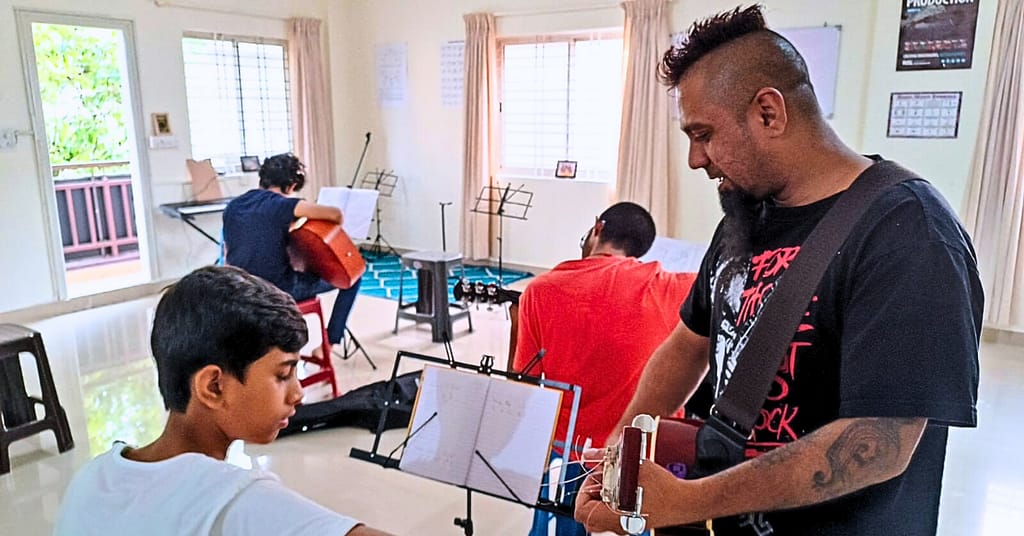
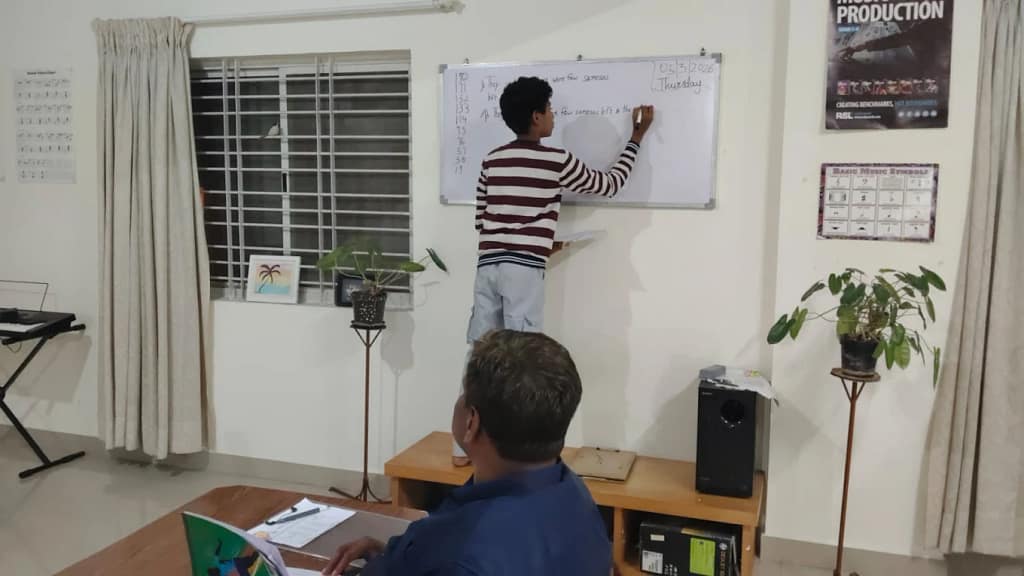
The First Chord Academy in Banaswadi is one of the few places in Bangalore where your child can learn music and receive academic tuition under the same roof, in the same week, from a team that understands how the two connect.
Our music classes — guitar, keyboard, and ukulele — are structured around the same principles of pattern recognition and progressive skill-building that underpin strong academic learning. Students move through defined levels, from Beginner to Professional, with clear milestones and regular assessments.
Our academic tuition covers Class 1 to 10, across CBSE, ICSE, and State Board curricula, in small batches of maximum six students. Every child receives individual attention. Every session is aligned to their school syllabus.
We don’t believe music and academics are in competition. We’ve seen too many children who became more focused, more patient, and more confident in their schoolwork after a few months of consistent music lessons. The connection is real. We see it every week.
What Parents Say
“We were looking for the best academic tution in banaswadi for our 4th grade son who was struggling. With math concepts.The first chord Academy has been a lifesaver. The 1:1 attention is real his teacher actually takes the time to explain the ‘why’ behind the logic. Highly recommended for the primary schools tudents.”
— Anthony
“I was looking for a good math and science tution in Banaswadi and found TFC Academy. Really happy with the coaching. My son’s confidence in Math has definitely gone up. Would definitely recommend for Grade 1-10 students.”
TFC has transformed into a proper learning academy. The tution section is very well organized. They help with daily homework and exams, which takes a lot of pressure off us parents
— Kavya
The Practical Takeaway for Parents
You don’t have to choose between music and academics for your child. The research is clear that structured music education — particularly started young and continued consistently — actively supports mathematical development rather than competing with it.
If your child is in Class 1 to 10 and you’re looking for a place that takes both seriously, The First Chord Academy in Banaswadi offers both music classes and academic tuition, taught by specialist teachers in small, focused groups.
A free trial class is available for music. A free assessment session is available for academic tuition. There’s no commitment and no charge — just come in and see how your child responds.
📲 WhatsApp 8217506289 to book a trial or assessment.
📍 Above IDBI Bank, Subbanapalya, Banaswadi, Bengaluru 560043
🌐 thefirstchord.com
Eric Rodrigues is the founder of The First Chord Academy and teaches guitar, keyboard and ukulele personally. TFC offers music classes and academic tuition for Class 1–10 in Banaswadi, Bangalore.