Choosing a music tutor in Bangalore is not as simple as finding the nearest academy or the cheapest monthly fee.
The teacher your child learns from in the first year shapes everything that comes after — what habits they build, whether they enjoy playing, how quickly they progress, and whether they stick with it or quietly give up after six months.
This is a list of seven honest questions worth asking any music teacher or academy before enrolling — including TFC. At the end of each one, I’ll tell you how we answer it.
1. Does the Teacher Perform Professionally — or Just Teach?
This is the first question and the most important one.

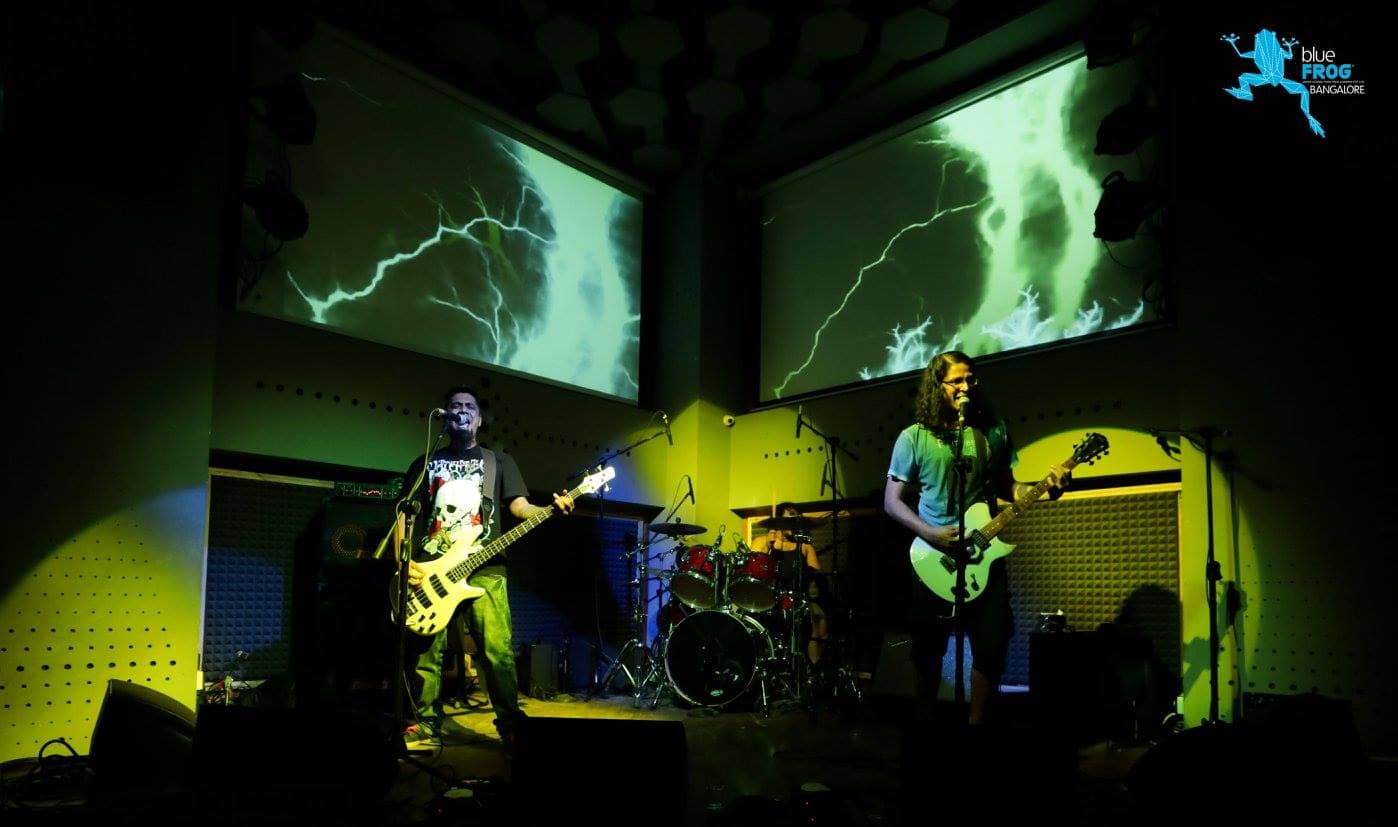








There is a real difference between a teacher who studied music and a teacher who plays it — who has stood on a stage, performed in front of an audience, figured out why something sounded wrong in a live setting and fixed it in real time.
A teacher who only teaches can give you correct information. A teacher who performs can give you something harder to come by — the instinct for how music actually behaves in practice, not just in theory.
For a child learning guitar, the difference shows up in how rhythm is taught, how tone is approached, how mistakes are corrected, and crucially — in the kind of music the teacher is excited to share.
How TFC answers this: I have been performing for over twenty years — as lead guitarist with Twisted Mischief, Ledge 13, Quarter Fret, and Negative Zero across Bangalore. Music is not what I studied. It is what I do. That comes through in every class.
2. What Is the Batch Size?
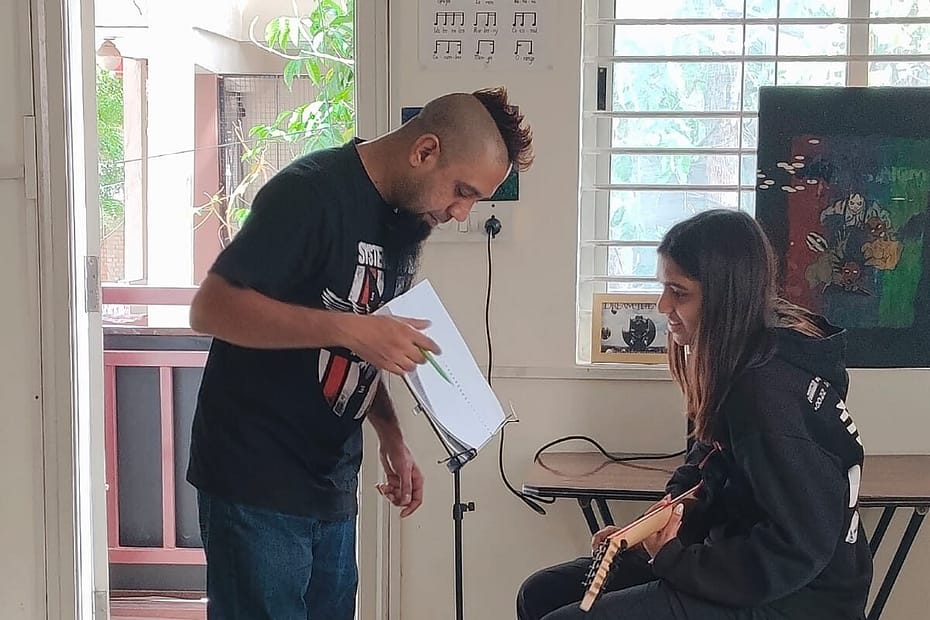
Batch size is directly linked to how much individual attention your child receives in a class.
In a batch of fifteen or twenty, a teacher delivers content and moves on. There is no realistic way to notice every wrong finger position, every missed beat, every incorrect chord shape across twenty students in one hour.
Most of those things go uncorrected. The child practises the wrong thing at home all week. And the wrong thing, practised a thousand times, becomes a habit that takes months to fix.
Small batches are not a luxury. They are the mechanism by which individual correction actually happens.
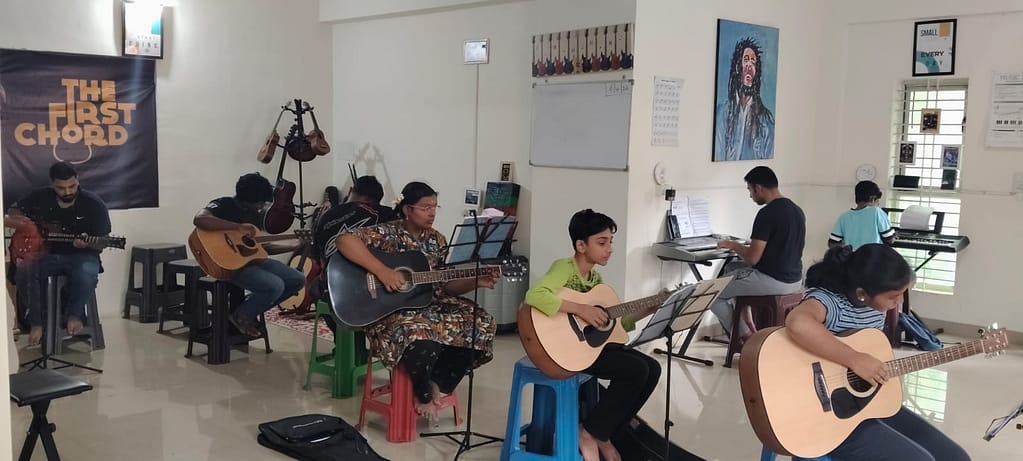
How TFC answers this: TFC classes have a maximum of eight students per batch. Not ten — max of eight. At that number, every student can be seen and corrected in every session. Anything larger and individual attention becomes a marketing claim rather than a reality.
3. How Is Progress Tracked and Reported?
If you ask a music teacher “how is my child doing?” and the answer is “really well, they’re improving a lot” — without specifics — that is not progress tracking. That is reassurance.
Genuine progress tracking means knowing what level a student is at, what concepts they have covered, what the next milestones are, and how long it is likely to take to reach them.
It also means communicating this to parents in a way that is understandable and actionable — not buried in jargon.
How TFC answers this: Every student at TFC follows a structured curriculum with defined levels and clear milestones. Parents are kept informed of what their child is working on. Assessments are built into the curriculum — not as pressure events but as check-ins that tell both the teacher and the parent exactly where the student is.
4. Is There a Curriculum — or Is Teaching Ad Hoc?
Ask this question directly. Some teachers will have a clear answer. Others will give you something vague — “we adapt to the student’s pace” or “we go wherever their interests lead.”
These answers are not wrong in isolation. But in the absence of a structured curriculum underneath them, they are often a cover for no plan at all.
A structured curriculum means that someone sat down and worked out the right order to teach things — what needs to come before what, which skills unlock which, how long each stage typically takes, and what “done” looks like at each level.
Without that structure, a child can spend two years playing the same three songs and feel like they’re making progress when they are, in fact, standing still.
How TFC answers this: Every instrument at TFC — guitar, keyboard, ukulele — is taught through a structured, progressive curriculum. Every class has a defined objective. Skills build on each other in a deliberate sequence. A student always knows what they are working towards and what comes next.
5. Can You Do a Trial Class First?
Any good music teacher or academy should be willing to let a new student experience the teaching before committing to payment.
A trial class answers things a website or a phone call cannot: Does the child respond well to this teacher’s style? Does the environment feel right? Does the pacing suit them? Is this the right fit?
An academy that is not willing to offer a trial class is, in effect, asking you to buy something blind. That is not a confidence indicator.
How TFC answers this: Every new student at TFC gets a free trial class — no charge, no commitment. Come in, experience one session, see how your child responds, and make the decision with that information.
If it is not the right fit, you will know. If it is — then you have already started.
6. What Happens If a Class Is Missed?
This question matters more than most parents think to ask — and the answer tells you a lot about how an academy is run.
If a teacher misses a class without warning and without arranging a replacement — that is a red flag. It means the student’s time is not being treated as valuable.
If a student misses a class due to illness or a school event — the policy should be clear. Is the class compensated? Is the fee for that class adjusted? Or does the academy simply absorb it with no alternative offered?
How TFC answers this: If a class is missed by the teacher, a compensation session is arranged within a reasonable period and parents are informed in advance. If a student misses a class, we do our best to accommodate a makeup session based on availability. The communication is always upfront — not something you have to chase.
7. How Does TFC Answer All Six of These?
The reason I wrote this post is not to tell you TFC is the only option. It is to give you a framework that helps you make a better decision — whether that decision ends up being TFC or somewhere else.
That said, here is how The First Chord Academy answers every question on this list:
Performing professionally? Yes — over twenty years. Twisted Mischief, Ledge 13, Quarter Fret, Negative Zero.
Batch size? Maximum eight students per batch.
Progress tracked? Structured curriculum with defined levels. Parents kept informed at every stage.
Curriculum or ad hoc? Fully structured curriculum for all instruments.
Trial class? Free. No charge. No commitment. One class — experience it first.
Missed class policy? Compensation sessions arranged. Parents informed upfront.
If all six answers pass your test — we would love to have your child in for a trial class at TFC.
Book a Free Trial at TFC
Guitar, keyboard, and ukulele classes at The First Chord Academy, Banaswadi — for children and adults, all levels, all ages.
📲 WhatsApp 8217506289 to book a free trial class.
📍 Above IDBI Bank, Subbanapalya, Banaswadi, Bengaluru 560043
🌐 thefirstchord.com
TFC Fast Track — Learn to Play Guitar, Keyboard or Ukulele in 8 ClassesFor adults who want to learn faster — TFC Fast Track is 8 private 1:1 weekend sessions at ₹15,000. Start any weekend. No prior experience needed.
Eric Rodrigues is the founder of The First Chord Academy in Banaswadi, Bangalore. He has performed as lead guitarist with Twisted Mischief, Ledge 13, Quarter Fret, and Negative Zero, and has taught guitar, keyboard, and ukulele at TFC since its founding.