When parents ask about the handwriting classes for children at TFC Banaswadi, the question underneath is usually a simpler one: does this actually matter, or is it something that fixes itself as children get older?
The honest answer is that it doesn’t fix itself. And the longer it’s left, the harder it is to correct.
Here is why handwriting is one of the most consequential skills a child can build — and why the window to do it properly is earlier than most parents realise.
Why Handwriting Is Judged in Every Subject
Consider what your child’s school day actually involves.
Maths. Science. English. History. Hindi. Second language. Social studies. Every single one of these subjects requires your child to write — in class exercises, homework, tests, and examinations.
That means their handwriting is being seen and evaluated, implicitly or explicitly, in every subject, every single day, for the duration of their school life.
This is not a small thing. It is, in fact, the one skill that crosses every subject boundary — the common denominator of all academic output from LKG through Class 12.
A child whose handwriting is clear, consistent, and well-formed carries that advantage into every classroom, every exam hall, and every notebook check for the next twelve years. A child whose handwriting is messy, incorrectly formed, or painfully slow carries that disadvantage into the same.
What Poor Formation Looks Like — and What Corrected Looks Like
Most parents recognise poor handwriting when they see it. What they often don’t recognise is the specific mechanism causing it.
Poor handwriting in children is almost never a question of effort or intelligence. It is almost always a question of incorrect formation habits that were never addressed at the right time.
Here is what incorrect formation typically looks like in practice:
Letters formed in the wrong direction — a child who writes the letter ‘d’ by drawing the circle first then the stick, rather than the correct stroke sequence, will always produce slightly irregular letterforms, no matter how carefully they try. The wrong motor pathway is already set.
Inconsistent letter sizing — capital and small letters mixed up, letters that change height from one line to the next, words where the letters vary in size without pattern. This is a spacing and proportion issue that comes from never having been taught the correct proportions.
Writing that deteriorates over time — a child whose handwriting looks acceptable for the first few lines but becomes progressively messier by the bottom of the page is experiencing grip fatigue. Their pencil hold is using the wrong muscles, and those muscles tire quickly under sustained writing.
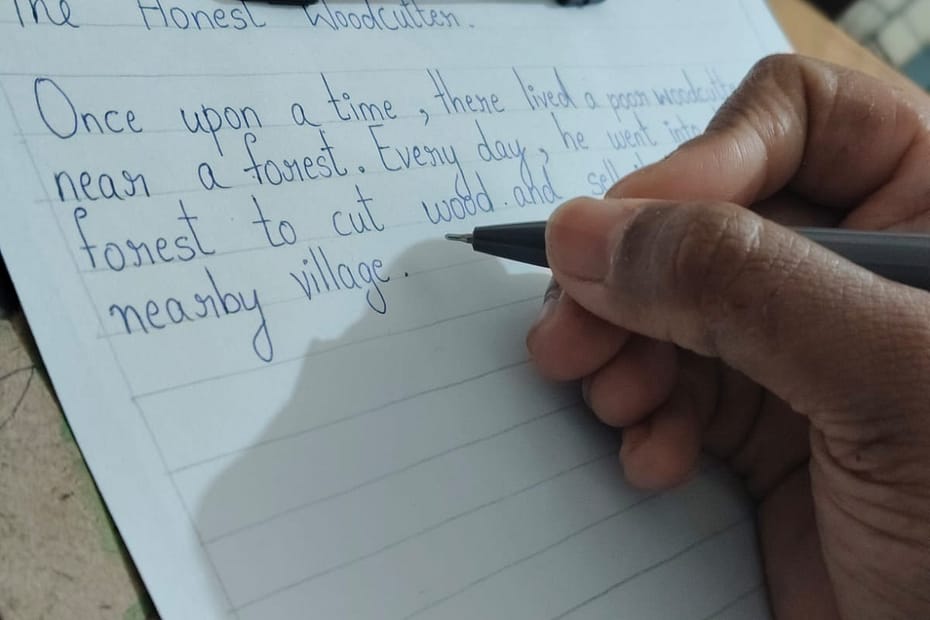
What corrected handwriting looks like is not perfect calligraphy. It is consistent, legible, appropriately sized and spaced, and sustainable — a child can write a full page without the quality visibly dropping.
That consistency is the goal. And it is entirely achievable with the right teaching at the right time.
How Teachers Perceive Neat vs Messy Writing
This is something most teachers notice and few say out loud.
When an examiner or teacher reads a child’s paper, they encounter the handwriting before they encounter the content. The first impression — formed in the first two seconds of looking at the page — is almost always a handwriting impression.
A child with clear, neat, consistently formed handwriting is perceived as more organised, more capable, and more serious. That perception does not disappear when the examiner begins to read. It colours the reading. Correct answers are more likely to be given full marks. Partially correct answers are more likely to be given the benefit of the doubt.
A child with messy, difficult-to-read handwriting faces the opposite effect. The examiner must work harder to decipher the content. When the content is ambiguous — a borderline answer, an unclear calculation, a sentence that could be read two ways — the illegible paper gets less grace.
This is not unfair. It is simply how human beings process written information. Legibility reduces cognitive load. When reading is easy, evaluation is more generous. When reading is difficult, evaluation becomes more demanding.
Research in educational psychology has documented this effect consistently — the same content, presented in neat versus messy handwriting, receives measurably different marks from evaluators who are unaware they are reading identical answers.
The child with the neater paper has an objective advantage. That advantage compounds over twelve years of academic evaluation.
The Window to Fix It — Why LKG to Class 5 Matters
The reason the LKG to Class 5 window matters so much comes down to how motor skills are learned.
Handwriting is a motor skill — not an intellectual one. Like learning to ride a bicycle or play a musical instrument, the physical movements involved in forming letters become increasingly automatic with repetition.
This automaticity is the goal: a child who has to consciously think about how to form each letter writes slowly, tires easily, and cannot focus on the content they are writing because cognitive resources are being spent on the mechanics of writing itself.
The problem with incorrect formation is that repetition works in both directions. A child who practises incorrect letter formation thousands of times over several years does not simply have incorrect habits — they have deeply ingrained incorrect motor pathways that require deliberate, sustained effort to override.
From LKG to approximately Class 2, children are still building these pathways. Correction at this stage is relatively straightforward — the patterns are not yet set, and the child has not spent years reinforcing them. A few months of correct teaching can establish the right foundation.
From Class 3 to Class 5, correction is still very achievable but requires more consistent effort. The habits are more established but are not yet so deeply automatic that they resist correction.
From Class 6 onwards, incorrect handwriting habits are genuinely difficult to fix. The child has written incorrectly for six or more years. The motor pathways are automatic. Changing them requires overriding deeply embedded patterns, which is possible but takes significantly longer and is more frustrating for the child.
This is the window. LKG to Class 5 is when structured handwriting teaching produces results most efficiently, most quickly, and most durably.
What the TFC Handwriting Course Covers
The Handwriting Course at The First Chord Academy in Banaswadi is available for children from LKG to Class 5.
It is a structured, progressive course — not a generic penmanship drill. Every session builds on the previous one, and every child receives individual attention and feedback specific to their particular formation habits and grip.
The course covers:
Print writing and letter formation — the correct stroke sequence for every letter of the alphabet, both capital and small. This is the foundation. If formation is wrong here, everything built on top of it will carry that error forward.
Pencil grip and sitting posture — the tripod grip, how to hold the pencil at the correct angle, and how to sit so that the writing arm can move freely without tiring. Most children with messy or fatiguing handwriting have a grip or posture issue — often both.
Capital and small letters — the correct sizing relationship between uppercase and lowercase, when each is used, and how to maintain consistency across a full line and a full page.
Cursive and joint handwriting — the transition from print to joined handwriting, the correct joining strokes between letters, and how to build speed in cursive without sacrificing legibility. Most schools begin this transition in Class 2 or 3 and do not always complete it before moving to the next part of the curriculum.
Speed writing — writing faster without losing neatness. This is a skill that must be built deliberately — simply writing faster does not produce it. The correct technique builds fluency at speed.
Neatness, spacing, and alignment — consistent letter height, even spacing between letters and between words, and keeping writing aligned on the line.
Sentence practice — applying all of the above in connected writing. Individual letters that look correct in isolation sometimes break down in continuous writing. Sentence practice closes that gap.
Classes run on Monday, Wednesday, and Saturday. Each session is one hour. The fee is ₹1,500 per month plus ₹500 for materials — all materials are provided at the academy.
Book a Free Trial Class
If your child is between LKG and Class 5 and their handwriting needs structured attention — we invite you to come in for a free trial class at TFC.
No charge. No commitment. One session in a small group, with individual feedback. See what structured teaching looks like in practice.
📲 WhatsApp 8217506289 to book a free trial.
📍 Above IDBI Bank, Subbanapalya, Banaswadi, Bengaluru 560043
🌐 thefirstchord.com
The First Chord Academy in Banaswadi, Bangalore offers a structured Handwriting Course for children from LKG to Class 5, alongside music classes and academic tuition for Class 1 to 10. Small groups. Individual attention.